What to Check Before Hiring a Custom Home Builder
Hiring a custom home builder is one of the most important decisions you’ll make. Get it right, and you end up with a home built exactly for your life. Get it wrong, and you’re dealing with delays, budget overruns, and compromises you never agreed to.
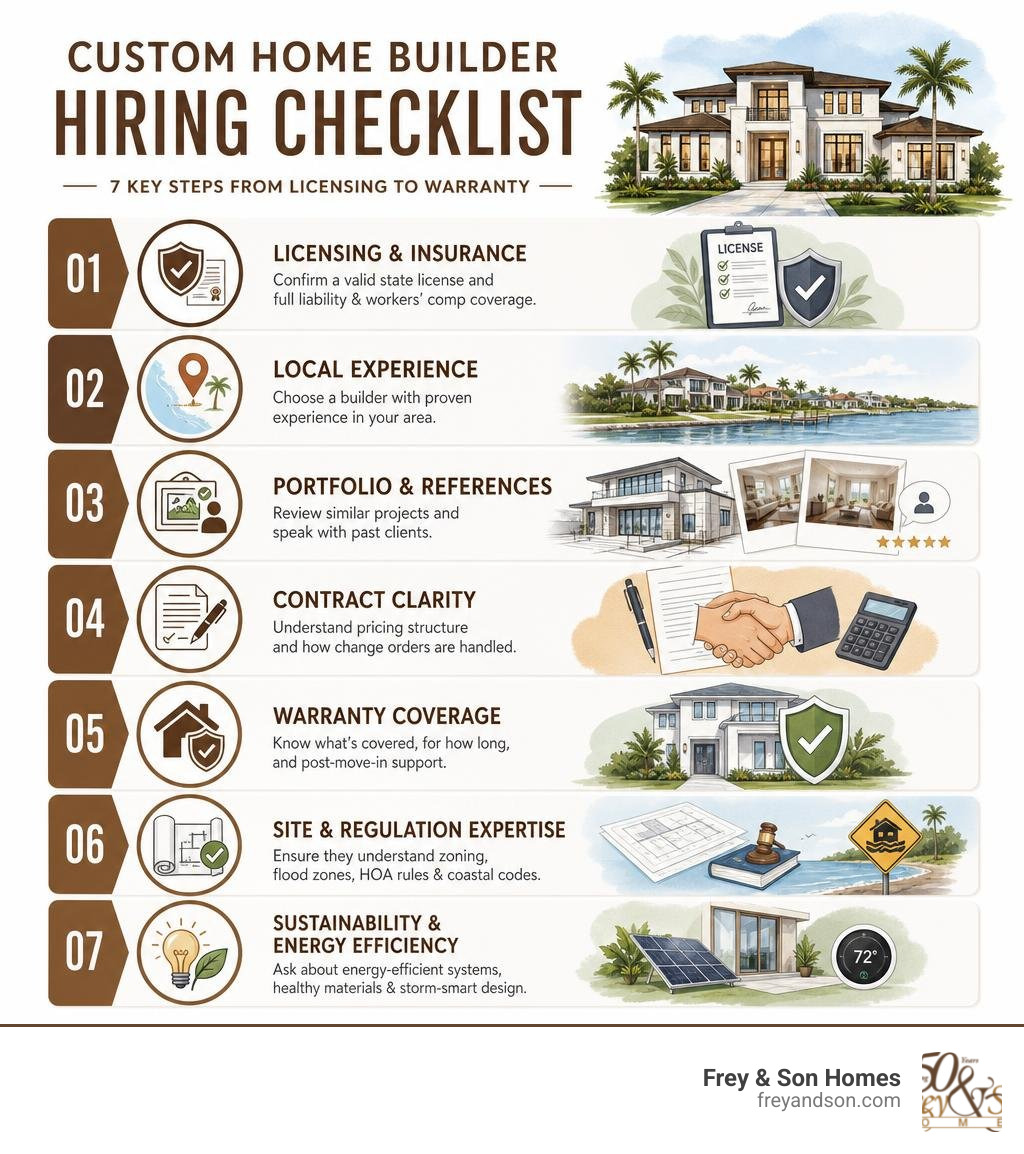
Here’s a quick look at the key things to verify before you sign anything:
- Licensing and insurance — Confirm they hold a valid state contractor’s license and carry full liability and workers’ comp coverage.
- Local experience — Look for a proven track record in your specific area, especially for coastal or Southwest Florida construction.
- Portfolio and references — Review completed homes similar to what you want, and actually talk to past clients.
- Contract clarity — Understand whether it’s fixed-price or cost-plus, and how change orders are handled.
- Warranty coverage — Know what’s covered, for how long, and what post-move-in support looks like.
- Site and regulation expertise — Verify they understand local zoning, flood zones, HOA rules, and coastal building codes.
- Sustainability and energy efficiency — Ask how they approach high-efficiency systems, healthy materials, and storm-smart design.
The U.S. custom home market was valued at approximately $36.5 billion in 2023 and is growing fast — meaning more builders are entering the space, and not all of them are equal. Over 70% of custom home buyers say personalization and energy efficiency are their top priorities. Yet many homeowners still struggle to find a builder who can deliver on both without the stress.
That’s especially true in Southwest Florida, where coastal regulations, hurricane resilience, and outdoor living design add a layer of complexity that most out-of-area builders simply aren’t equipped to handle.
I’m Micheal Ouellette, Vice President of Sales and Business Development at Frey & Son Homes, and I’ve spent more than 27 years guiding clients through the custom home builder selection and construction process across Southwest Florida’s most prestigious residential markets. In this guide, I’ll walk you through exactly what to look for — so you can make a confident, informed choice.
1. The Builder’s Classification and Process
Before you start vetting individual companies, it is crucial to understand what kind of builder you actually need. Home builders generally fall into three distinct categories: production, semi-custom, and custom.
A true custom home builder offers a blank slate. You work alongside architectural designers to create a one-of-a-kind home on land you own or acquire. This path grants you absolute design control and complete architectural freedom. Every wall placement, ceiling detail, and outdoor living layout is tailored specifically to your family’s lifestyle.
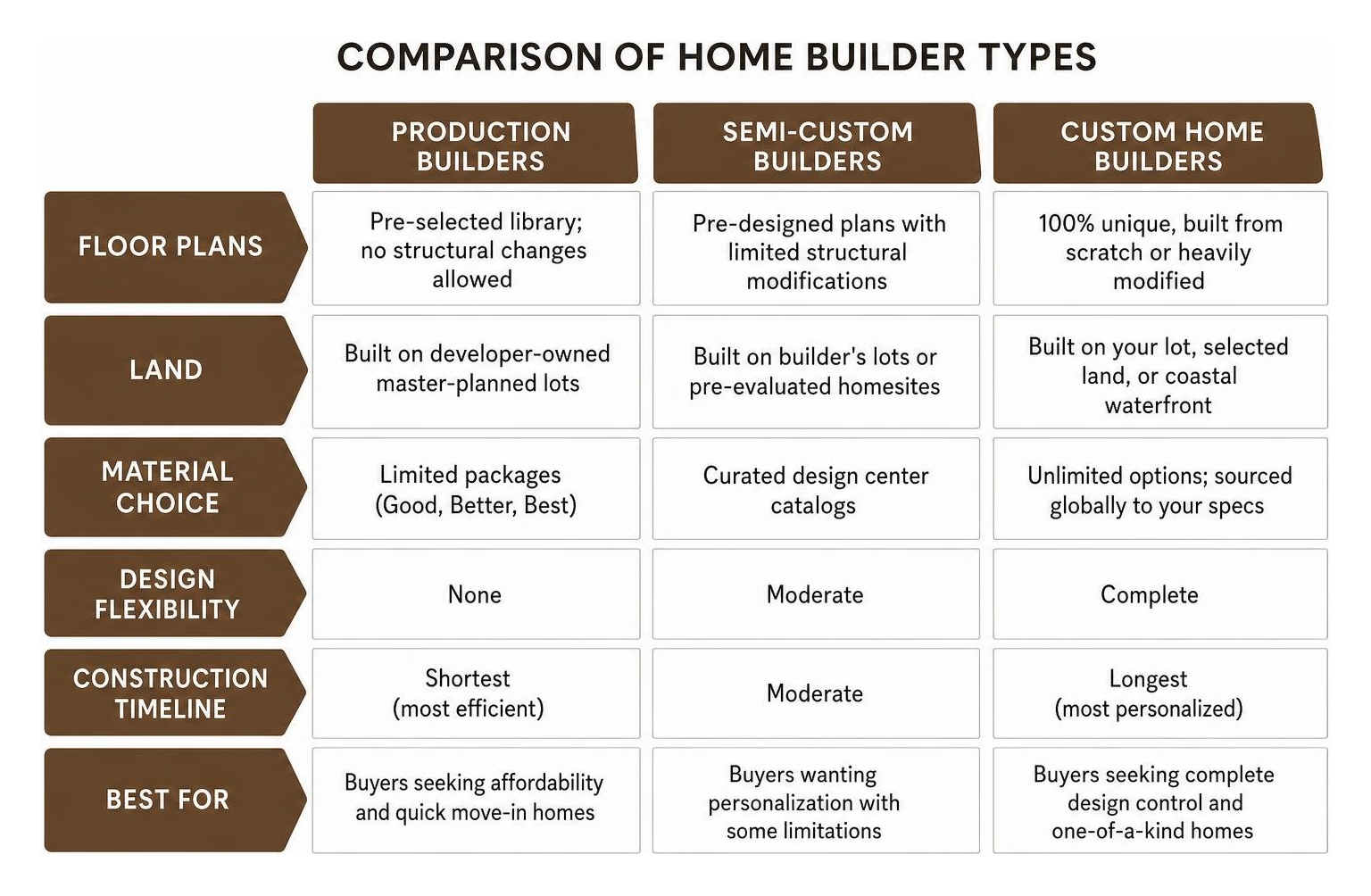
| Feature | Production Builders | Semi-Custom Builders | Custom Home Builders |
|---|---|---|---|
| Floor Plans | Pre-selected library; no structural changes allowed | Pre-designed plans with limited structural modifications | 100% unique, built from scratch or heavily modified |
| Land | Built on developer-owned master-planned lots | Built on builder’s lots or pre-evaluated homesites | Built on your lot, selected land, or coastal waterfront |
| Material Choice | Limited packages (Good, Better, Best) | Curated design center catalogs | Unlimited options; sourced globally to your specs |
| Architectural Style | Highly standardized suburban designs | Modified regional styles | Coastal contemporary, transitional, or custom estate |
| Price Point | Lower per sq. ft. due to economies of scale | Mid-range with standard upgrade pricing | Premium pricing based on materials and complexity |
How a Custom Home Builder Differs from Production Builders
The primary difference lies in personalization and decision-making power. Production builders construct hundreds of identical homes across master-planned subdivisions. They achieve lower costs by buying materials in bulk and repeating the same blueprints. If you want to move a wall, expand a lanai, or upgrade to a high-performance hurricane-rated glass system that isn’t on their standard list, you are out of luck.
When you hire a true custom home builder, you are investing in a highly personalized service. The process is collaborative, allowing you to design around specific Southwest Florida features like maximizing a canal view in Cape Coral, integrating a seamless indoor-outdoor transition for a Naples lanai, or engineering a single-story layout that maximizes natural light.
Understanding the Benefits of Working with a Local Family-Owned Builder can help clarify why this personalized approach is so distinct. A local, family-owned firm brings multi-generational expertise and deeply rooted relationships with local trades, ensuring your custom built home is crafted to stand the test of time.
2. What to Look For in a Reputable Custom Home Builder
Once you commit to the custom route, the vetting process begins. Building a custom home is a long-term relationship, often lasting anywhere from 12 to 24 months from initial design to final walkthrough. You need a partner who is not only highly skilled but also deeply transparent.

When you begin researching, prioritize these three non-negotiables:
- Active, Unlimited Licensing: In Florida, custom builders must hold an active Certified Builder or Certified General Contractor (CGC) license. Verify this directly through the Florida Department of Business and Professional Regulation (DBPR).
- Comprehensive Insurance Coverage: Ensure the builder carries substantial general liability insurance and active workers’ compensation. This protects you from legal and financial liability if an accident occurs on your homesite.
- A Solid Local Portfolio: Look for a portfolio that showcases architectural diversity. If a builder’s portfolio consists of homes that all look identical, they may struggle to execute a unique, one-off design.
To organize your search, read our guide on What to Look for in a Custom Home Builder and learn the most effective Ways Research Home Builders Reputation through third-party reviews, past client interviews, and local construction registries.
Evaluating Experience and Local Track Record
Southwest Florida’s coastal environment is beautiful, but it presents incredibly harsh building conditions. Salt air, high humidity, shifting sandy soils, and severe weather patterns require specialized engineering. A builder who primarily operates in landlocked states or non-coastal areas may not understand the nuances of building in Collier or Lee County.
When you begin to Create Your Custom Home Builder Short List, prioritize firms with decades of local experience in Naples, Marco Island, Bonita Springs, and Cape Coral. Ask potential candidates how long they have built specifically in these municipal jurisdictions.
For more tips on narrowing down your options, review our curated Tips Find the Right Home Builder. Choosing a builder with a 50-year local track record means they have navigated multiple economic cycles, established deep relationships with the area’s best subcontractors, and mastered the local building codes.
3. Site Evaluation and Coastal Regulation Expertise
You might find what seems to be the perfect vacant lot in Naples or Marco Island, but before you close on the land, you need a custom home builder to perform a comprehensive site evaluation. Southwest Florida geography is highly complex, and buying a lot without a feasibility study can lead to unexpected site-prep costs that eat up your construction budget.
The core principles of client-builder relationships and site diligence remain identical across any high-end market. However, our local geography demands highly specific expertise.
An experienced local builder will evaluate:
- Soil Conditions & Bearing Capacity: Many coastal lots require extensive soil compaction, muck removal, or pilings to support a heavy concrete block structure.
- Elevation and FEMA Flood Maps: The Federal Emergency Management Agency (FEMA) establishes strict base flood elevations. Your builder must design the home’s finished floor elevation to meet or exceed these requirements, directly impacting your home insurance premiums and architectural design.
- HOA and Architectural Review Committee (ARC) Rules: Master-planned communities in Naples and Bonita Springs often have strict guidelines governing roof pitches, exterior paint colors, setbacks, and landscape design.
Navigating Local Zoning and Environmental Rules
Building near the Gulf of Mexico means dealing with overlapping regulatory bodies. In addition to local city and county building departments, projects seaward of the Coastal Construction Control Line (CCCL) require permits from the Florida Department of Environmental Protection (FDEP). These regulations protect our delicate beach dune systems and ensure homes are engineered to withstand extreme storm surges.
Navigating these complex environmental rules requires a builder with localized, boots-on-the-ground experience who understands how to coordinate with state and local agencies.
For those looking to buy land, checking resources like Build On Your Lot Homebuilders in Lee County, FL | 80 Builders can help you understand lot availability, while consulting the Best Luxury Home Builders Cape Coral 2026 can provide insight into who possesses the specialized engineering skills required for waterfront canal builds. A qualified local builder will always emphasize the importance of site-specific engineering to protect your investment.
4. Financial Transparency, Contracts, and Warranties
A custom build represents a significant financial investment. To protect your capital, you must understand how your builder structures their contracts and manages financial transactions.
There are two primary contract structures used by custom home builders:
- Fixed-Price Contracts: The builder provides a single, locked-in price for the entire scope of work based on detailed architectural plans and selections. This structure transfers the risk of material price spikes to the builder, giving you peace of mind and budget predictability.
- Cost-Plus Contracts: You pay the actual cost of materials and labor, plus a set percentage or flat fee for the builder’s management. While this offers maximum flexibility for making changes during construction, it requires absolute transparency and carries the risk of budget inflation.
To ensure you select the appropriate financial framework, follow our 3 Steps for Choosing the Right Home Builder for Your Project.
Understanding Financing and Warranty Protections
Unlike buying an existing home with a traditional mortgage, building a custom home typically requires a construction-to-permanent loan. This loan pays the builder in stages (known as “draws”) as specific construction milestones are met and verified by bank inspections.
Before signing a contract, make sure to ask the builder about their warranty program. A reputable builder should provide a comprehensive multi-tiered warranty, including:
- A 1-year warranty on workmanship and materials.
- A 2-year warranty on mechanical systems (plumbing, electrical, HVAC).
- A 10-year structural warranty backed by a third-party insurance provider.
Be sure to prepare by reviewing these 4 Important Questions for Your Custom Home Builder to protect your investment and ensure long-term peace of mind.
5. Sustainable Materials and Energy-Efficient Technologies
Modern luxury custom homes in Southwest Florida are designed to be highly energy-efficient, healthy, and resilient. Incorporating sustainable materials and advanced building sciences not only reduces your carbon footprint but also lowers your monthly utility bills and improves indoor air quality.
When building a custom home, prioritize high-performance features such as:
- Unvented, Insulated Attics: Spraying open-cell polyurethane foam insulation along the roofline seals the attic, keeping it within a few degrees of your living space and reducing the workload on your HVAC system.
- High-Efficiency Variable-Speed HVAC Systems: These systems continuously adjust their speed to maintain consistent indoor temperatures and superior humidity control, which is vital for preventing mold growth in Florida’s humid climate.
- Low-VOC and Non-Toxic Materials: Specifying paints, adhesives, and cabinetry that are free of volatile organic compounds (VOCs) ensures your family breathes clean indoor air from day one.
Incorporating Smart Home and Eco-Friendly Features
A forward-thinking custom builder integrates modern technologies directly into the structural design of the home. This includes pre-wiring for solar panel arrays, installing electric vehicle (EV) charging outlets in the garage, and designing smart home automation systems that manage lighting, security, and climate control from a single device.
In addition, your home’s exterior envelope must be designed for maximum resilience. Impact-resistant glass windows and doors are essential for protecting against hurricane-force winds and flying debris, while also providing excellent sound dampening and UV protection to keep your interior finishes from fading under the Florida sun.
Frequently Asked Questions about Custom Home Building
How do I prepare for my first meeting with a custom home builder?
To get the most out of your initial consultation, bring any design inspiration you have gathered (such as photos, sketches, or floor plans), a clear idea of your maximum budget, and information about your lot if you already own land. Most importantly, bring a list of your family’s daily lifestyle priorities — how you cook, entertain, and relax will dictate the flow of your custom floor plan.
How do builders manage change orders without exceeding the budget?
Reputable builders use a structured change-order process. Any modification to the original contract must be documented in writing, detailing the exact cost adjustment and timeline impact. Construction should only proceed once you have signed off on the change order. Holding a 5% to 10% contingency fund in your overall budget is also highly recommended to cover any design changes you decide to make along the way.
What are the warning signs of a bad builder?
Red flags include a builder demanding a large, non-refundable upfront deposit before any plans are drawn, a history of frequent litigation or unresolved complaints with the state licensing board, vague or incomplete contracts that lack itemized pricing, and poor communication or evasive answers during your initial interviews.
Conclusion
Building your dream home in Southwest Florida should be an exciting and rewarding journey, not a source of constant stress. By performing your due diligence, verifying licensing, evaluating local coastal expertise, and demanding financial transparency, you can select a builder who will bring your vision to life with precision and care.
At Frey & Son Homes, we have spent over 50 years perfecting our craft across Naples, Cape Coral, Marco Island, and the surrounding communities. Our multi-generational team combines architectural innovation with unmatched local building expertise, ensuring your home is as beautiful as it is resilient.
To learn more about how we bring your vision to life, explore The Frey Son Approach. If you are ready to work with one of Southwest Florida’s premier builders, read about our legacy as Award-Winning Home Builders Crafting Southwest Floridas Finest Custom Homes and take the first step toward your new home today when you Build Your Dream Home with Frey & Son Homes.